
In the United States, every healthcare practice runs into the same problem at some point. A new provider is hired, fully qualified and ready to treat patients, but the business can not bill insurance or get paid. Most of the time, the reason is simple:
Provider credentialing and insurance enrollment are not completed.
Knowing these two methods is essential for each healthcare practice, hospital, and medical group. When performed perfectly, they support providers in beginning to notice insured patients and getting paid on time. When it gets delayed, it can slow down the cash flow and decrease income.
This article describes provider credentialing and payer enrollment in the USA to easily understand. It covers every phase of the process and explains essential systems such as CAQH and PECOS, lists the documents you require, shares common issues to prevent, and indicates how to avoid delays. By the end, you will know what it takes to help a provider start billing insurance in some months instead of waiting six months or longer.
Credentialing and Enrollment are the two phases every US healthcare provides shloud complete before they can legally treat patients at a facility and get repaid by insurance. Credentialing verifies a provider’s education, skills, training, licensure, and professional background. On the other hand, Enrollment connects the verified provider to certain payers such as Medicare, Medicaid, and commercial insurers so that claims can actually be submitted and paid.

Credentialing and Enrollment are relevant but are different stages in bringing a provider completely online. Confusing them is one of the most common and costly errors that practices make.
Features | Credentialing | Enrollment |
What it answers | Is this provider qualified? | Can this provider bill insurance? |
Who grants it | Credentialing bodies, hospital credentialing committees | Insurance companies/payers |
Verifies | License, education, training, and work history | Credentialing status, network fit |
Governs | General fitness to practice medicine | Ability to get reimbursed |
Credentialing usually happens first. Although some enrollment stages can start at a similar time, the method cannot be completed until credentialing has been approved. Multiple providers and practice managers think credentialing and enrollment are the same method, but they are not.
A provider might be completely credentialed and still unable to bill insurance because their payer enrollment is not complete. This distinction between being qualified and being able to bill can delay payments and decrease a practice’s revenue. That is the reason why understanding both processes is important for each healthcare practice.
Credentialing is the general or formal process of ensuring that a healthcare provider’s education, training, licensure, and professional background meet the standards needed to provide care. It exists to provide hospitals, insurers, and regulators with confidence that the person delivering treatments is who they claim to be. It is also beneficial to protect patients and ensure the person can safely do the job. Credential verification generally covers:
No, redentialling is an ongoing procedure. Providers must regularly update their credentials, which involves renewing the license and upgrading the workings of their credentials. Maintaining current credentials confirms with insurance companies. It may also help update the working history and manage the malpractice insurance coverage.
There are types of medical credentialing, which involve:
The procedure of initial credentialing entails ensuring the credentials and the history of newly recruited healthcare professionals before they commence their practices.
Re-credentialing includes periodically verifying the background and qualifications of the healthcare professionals to confirm that their resumes meet industry standards.
Some of the steps are mentioned in detail below:
The providers (or the practice on their behalf) submit an application consisting of their complete professional record and supporting documentation.
Instead of trusting the documentation the provider submits, the credentialing body goes directly to the source, for example, medical school, state licensing boards, or previous employers, and the National Practitioners Data Bank (NPDB) to ensure everything is verified independently.
The verified data is compared against the provider’s submitted application and checked against the credentialing standards of the service or organization (many hospitals follow the NCQA or URAC framework).
For hospital-based providers, a Credentialing Committee or Medical Executive Committee formally reviews the file and approves the provider.
Credentialing is not a one-time event. Services and payers continuously monitor license status and sanctions, and providers must be re-credentialed on a recurring cycle, generally every two or three years or per the service contract terms.

Practices must maintain a standing, always current file for every provider consisting of:
Missing or outdated documents are the single most common cause of credentialing delays.
Payer Enrollment is also called provider enrollment or insurance enrollment and is the method of linking a credentialed provider to an insurance company’s network. It includes commercial payers such as UnitedHealthcare, Aetna, Cigna, and Blue Cross Blue Shield, as well as government plans such as Medicare and Medicaid. Enrollment is what actually permits a practice to submit claims and get reimbursed under a provider’s NPI and Tax ID. A provider can be completely credentialed and still unable to generate revenue if they are not enrolled with the payers their patients carry. This is the distinction that causes the most financial pain for new hires: care is being provided, but it can not be billed.
Here are some of the step-by-step processes that are mentioned below:
Step 01: Identify Target Payers
Step 02: Submit Applications
Step 03: Credentialing Validation
Step 04: Contracting and Rate Negotiation
Step 05: Approval and Activation
Enrollment directly determines cash flow. Providers who are not enrolled with the payer can still treat patients covered by that payer, but the practice that can not collect reimbursement for those visits. This means care is provided for free until enrollment is clear or the claims are written off completely. Enrollment also expands patient access: being in-network with more payers means more individuals can choose that practice.
Not every delay looks the same. Here is how they tend to break down:
Incomplete or outdated CAQH data is behind the large majority of stalled applications.
Missed Medicae/ Medicaid revalidation deadlines, which CMS has been compressing to occur more frequently.
A provider was technically approved but was never correctly linked to the billing NPI/Tax ID combination, producing silent denials after that fact.
Enrollment records that exist for one site but were never replicated for a second location or telehealth service.
Credentialing that lapses with individual MA plans, which often do not send advance expiration notices, unlike traditional Medicare.
A credentialing expert leaving mid-application retains institutional knowledge that is not documented anywhere else.
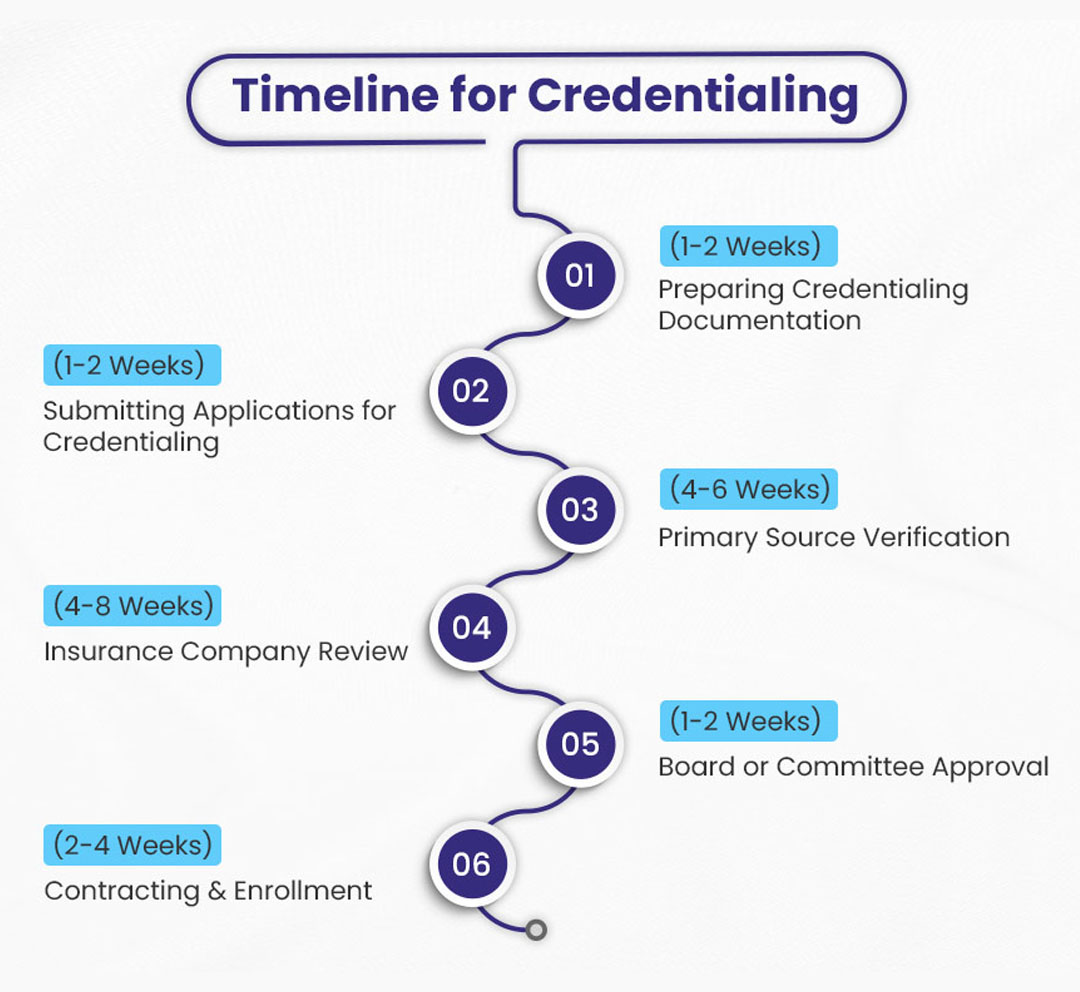
Process | Typical Timeline |
Commercial payer credentialing | 60–180 days |
Medicare (PECOS) enrollment | 2–3 months minimum |
State Medicaid enrollment | Up to 6–9 months in slower states |
CAQH re-attestation | Every 120 days |
CMS Primary Source Verification validity | 120 days (shortened from 180) |
Recredentialing | Every 2–3 years, per NCQA and CMS revalidation cycles |
Two centralized systems do most of the heavy lifting behind commercial and government enrollment in the USA.
The Council for Affordable Quality Healthcare (CAQH) maintains a centralized database used by the large majority of U.S. commercial health plans. Instead of filling out a separate credentialing application for every insurer, a provider maintains one standardized profile on CAQH, then authorizes specific payers to pull data directly from it.
CAQH profiles must be re-attested every 120 days. Missing this deadline blocks payers from accessing current credentialing data, which can trigger claim denials or even removal from a network, a completely avoidable problem that trips up a surprising number of practices.
CAQH does not cover federal programs. To bill Medicare, providers must enroll separately through the Provider Enrollment, Chain, and Ownership System (PECOS). Medicaid enrollment is handled through individual state-level portals, since Medicaid is state-administered.
Incomplete or outdated documentation | That singular biggest cause of delay. |
CAQH attestation lapses | An expired attestation silently blocks payer access to a profile. |
Gaps in work history | That needs additional explanation and documentation. |
Provider Not Found / Not on File claim denials. | Caused by enrollment records that are technically approved but not properly connected to the billing NPI/Tax ID combination. |
State-specific Medicaid quirks | Every state portal has its own rules, forms,s and turnaround times. |
Lack of centralized tracking | When credentialing status lives in spreadsheets or email threads instead of a single system, applications quietly stall. |
Because credentialing and enrollment sit at the intersection of compliance, administrative tracking, and revenue cycle management, many practices — especially smaller ones without a dedicated Medical Staff Office — outsource the function to a credentialing specialist or medical billing company.
Reasons practices commonly outsource:
Reasons practices keep it in-house:
There’s no universally correct answer — the right choice depends on practice size, growth rate, and how much administrative bandwidth is available internally.
Credentialing verifies who a provider is. Enrollment estimates whether they can get paid for doing it. Both procedures are sequential, document-heavy, and unforgiving of missing paperwork,k which is the reason why the 9- to 180 days are required for the onboarding window.
The practices that prevent revenue disruption are the ones that treat credentialing and enrollment as parallel. Proactively managed workflow starting the day a provider is hired, not as paperwork to catch up on after the provider has already begun seeing patients.

Credentialing and Enrollment in the USA: A Complete Guide to Faster Provider Approvals, Insurance Paneling, and Revenue Growth
At DocVaz Medical Billing, our experts will help healthcare providers to complete credentialing and enrollment accurately and on time. Our professional team works with Medicare, Medicaid, and commercial insurance companies to decrease delays, avoid costly errors, and support providers in getting payment faster. Whether you are a solo physician, a group practice, or a healthcare organization, DocVaz Medical Billing simplifies every step of the enrollment process so you can focus on patient care.
Provider credentialing is the process of verifying a healthcare provider's education, training, licenses, certifications, work history, and professional background before they can join an insurance network.
Provider enrollment is the process of registering an approved provider with Medicare, Medicaid, or private insurance companies so they can bill for healthcare services and receive reimbursement.
Credentialing verifies the provider's qualifications, while enrollment allows the provider to participate with insurance payers and receive payments for covered services.
The process usually takes 60 to 180 days, depending on the insurance payer, application accuracy, and whether additional documents are required.
CAQH is a centralized database where providers store their professional information. Many insurance companies use CAQH to review credentialing applications, making the process faster and more efficient.
Yes, providers may treat patients, but they generally cannot bill insurance as an in-network provider until enrollment has been approved, unless specific payer rules allow otherwise.
Common reasons include incomplete applications, expired licenses, missing documents, inaccurate information, delayed payer responses, or an outdated CAQH profile.
Most insurance companies require recredentialing every 2 to 3 years, although requirements vary by payer.